Introduction: Why AI Search Is Changing SEO Forever
Something remarkable happened between 2022 and 2026. Search — the fundamental way human beings discover information online — began the most significant transformation in its 25-year history.
In November 2022, OpenAI launched ChatGPT. Within two months, it reached 100 million users — the fastest product in history to hit that milestone. By 2024, it was processing over 10 million queries per day. In parallel, Google launched AI Overviews, which now appears at the top of billions of monthly searches. Perplexity AI crossed 15 million monthly active users. Anthropic’s Claude became a default tool for knowledge workers and professionals.
| Key Stats: Nearly 60% of Google searches now end without a click. Google AI Overviews appear for an estimated 15–20% of all queries and growing. A 2024 BrightEdge study found 51% of enterprise marketers said AI search was their top priority. |
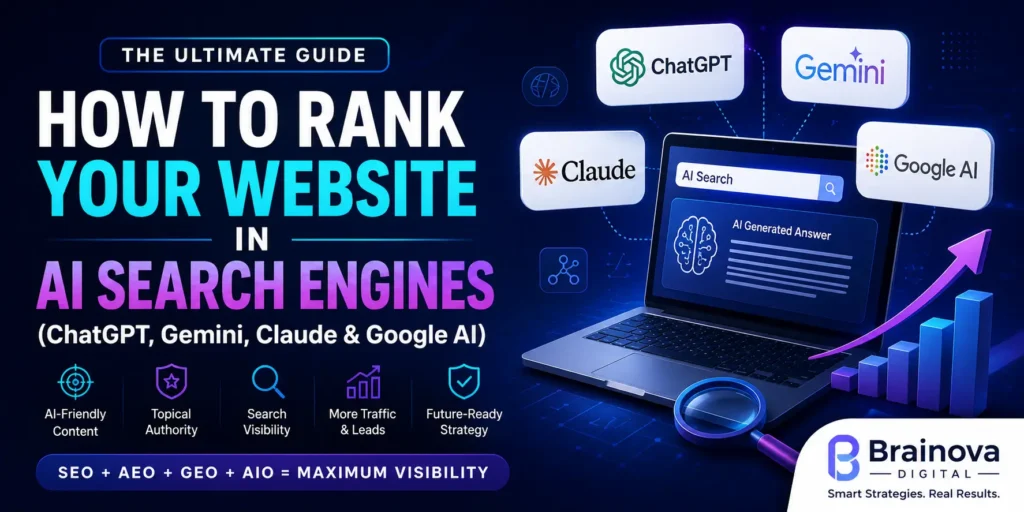
The businesses winning digital visibility in 2026 have built a four-layer strategy:
- SEO (Search Engine Optimization) — The Google traffic foundation
- AEO (Answer Engine Optimization) — Featured Snippets and AI Overviews
- GEO (Generative Engine Optimization) — Citations in ChatGPT, Claude, Gemini, Perplexity
- AIO (AI Optimization) — Semantic, NLP, and entity optimization across all systems
What Are AI Search Engines?
What is AI Search?
AI search refers to platforms that use artificial intelligence — large language models (LLMs), natural language processing (NLP), and retrieval-augmented generation (RAG) — to answer user queries by generating synthesized responses rather than returning a simple list of links.
How AI Search Works
Natural Language Processing (NLP)
The AI model interprets the user’s query using NLP — understanding not just the words used, but the intent behind them. This is fundamentally different from traditional keyword matching.
Semantic Search
AI search engines match meanings, not keywords. A query about ‘getting my company to show up when people ask ChatGPT’ will surface AI SEO content — even if those exact words aren’t in the query.
Entity Recognition
AI models understand the world through entities — discrete, real-world things (people, organizations, products, concepts) and the relationships between them. When your brand is a recognized entity, you’re far more likely to be cited.
Retrieval-Augmented Generation (RAG)
Platforms like Perplexity and ChatGPT (with web search) don’t rely solely on training data — they search the live web and use retrieved content to inform generated answers. This means real-time optimization has direct, measurable impact.
Top AI Search Engines: Platform Comparison
| Platform | Owner | User Base | Cites Live Web? | Best For |
| ChatGPT | OpenAI | 180M+ weekly | Yes (with search) | Research & B2B discovery |
| Gemini AI | Google/Alphabet | 1B+ devices | Yes | Google ecosystem queries |
| Claude AI | Anthropic | 50M+ users | Limited | Expert research & analysis |
| Perplexity | Perplexity AI | 15M+ monthly | Always | Cited research answers |
| Google AI Overviews | Billions/month | Yes (Google index) | Top-of-SERP visibility | |
| Bing Copilot | Microsoft | 140M+ monthly | Yes | Enterprise & B2B |
How AI Search Engines Choose Websites
Understanding why an AI cites one website and not another is the foundation of AI search optimization. After extensive analysis, these are the consistent signals AI platforms favor:
- Topical Authority — Comprehensive, deep coverage of a subject across a content cluster
- Semantic Relevance — Full conceptual coverage, not just keyword matching
- E-E-A-T Signals — Named authors, credentials, citations, organizational credibility
- Entity SEO — Brand recognized in AI entity graphs (Knowledge Graph, Wikidata)
- Brand Authority — Backlink quality, press mentions, cross-web citations
- Structured Data — Schema markup (FAQPage, Article, Organization, HowTo)
- Trust Signals — HTTPS, authorship, dates, privacy policy, contact info
- Content Freshness — Regularly updated, accurate, current information
- Citation Network — Most-cited sources in your niche get cited more by AI
SEO vs AEO vs GEO vs AIO: The Complete Framework
| Dimension | SEO | AEO | GEO | AIO |
| Target Platforms | Google, Bing | Google, Voice, AI Overviews | ChatGPT, Gemini, Claude, Perplexity | All AI systems |
| Core Focus | Rankings + traffic | Direct answers | AI citations | AI comprehension |
| Key Tactics | Backlinks, keywords | Schema, Q&A | Authority, data, entity | Semantic, NLP, entity |
| Time to Impact | 3–12 months | 4–8 weeks | 3–18 months | Ongoing |
| Measurement | Rankings, traffic | Snippet rate | Citation frequency | Quality scores |
Why Traditional SEO Alone No Longer Works
- Zero-click dominance: ~60% of Google searches end without a click
- AI Overview displacement: Organic CTR drops 15–30% when AI Overview appears
- Platform fragmentation: Customers research on Google, ChatGPT, Perplexity, and Gemini in one session
- Voice search: Over 1 billion monthly queries — all conversational, not keyword fragments
- Conversational queries: Natural language queries that traditional keyword SEO doesn’t serve
| If you’re only doing traditional SEO in 2026, you’re optimizing for one diminishing channel while your competitors build visibility across five growing ones. |
How to Rank in ChatGPT
How ChatGPT Chooses Sources
ChatGPT operates in two modes: base model (relies on training data up to early 2024) and web search enabled (live Bing search with real-time citation). For GEO, both modes matter — but real-time search is where immediate optimization pays off.
ChatGPT Ranking Factors
- Topical authority — comprehensive content cluster coverage
- Bing search visibility — ChatGPT live search uses Bing
- Domain authority and trust — high-DA, well-linked sites
- Content clarity — clean H1–H3 hierarchy, direct answers
- Original data and statistics — specific numbers make content citable
- E-E-A-T signals — named authors with verifiable credentials
- Recency — fresh content in web-search-enabled queries
- Brand entity recognition — named, established brands cited more reliably
ChatGPT Optimization Checklist
- Build comprehensive content clusters (pillar + 20+ supporting articles)
- Optimize for Bing (submit sitemaps to Bing Webmaster Tools)
- Write with direct answer-first structure in every section
- Include specific statistics with credible source citations
- Name your authors with full bios and credentials
- Build high-quality backlinks from industry-authoritative sites
- Implement Organization schema on your homepage
- Publish original research, surveys, or proprietary data
How to Rank in Claude AI
How Claude Understands Content
Anthropic designed Claude with a strong emphasis on accuracy, nuance, and genuine helpfulness. Claude tends to cite content that demonstrates deep expertise, clear reasoning, transparent sourcing, and precise language — making E-E-A-T optimization especially critical.
Claude is particularly popular with researchers, analysts, developers, and knowledge workers — making Claude optimization especially valuable for B2B companies, SaaS providers, and agencies.
Claude Optimization Checklist
- Write comprehensive long-form content (3,000+ words on competitive topics)
- Structure content with clear logical flow: premise — explanation — evidence — conclusion
- Cite all statistics with links to primary sources
- Add named author bios with verifiable credentials
- Define technical terms clearly when first introduced
- Include nuanced analysis that acknowledges counterarguments
- Use precise, specific language — avoid vague marketing claims
- Publish original research, analysis, or case studies
How to Rank in Gemini AI
The Google Ecosystem Advantage
Gemini is Google’s AI model, and it directly powers Google AI Overviews. This means one crucial thing: if you rank well on Google, you have a significant built-in advantage for Gemini visibility. Google’s traditional ranking signals feed directly into Gemini’s content selection.
Gemini Optimization Checklist
- Prioritize core Google SEO fundamentals as your Gemini foundation
- Build strong E-E-A-T signals at every level (author, site, content)
- Submit content to Google Search Console and ensure full indexation
- Implement comprehensive schema markup (Article, FAQPage, Organization, Person)
- Earn authoritative backlinks from industry publications
- Optimize Core Web Vitals (LCP under 2.5 seconds)
- Build complete Google Business Profile
- Structure content for AI Overview extraction
How to Rank in Google AI Overviews
The Anatomy of an AI Overview
Google AI Overviews appear at the very top of search results, generating synthesized answers that cite 3–6 source websites. Being cited generates brand exposure even without a click. Studies show AI Overview citations are disproportionately earned by pages already ranking in positions 1–5 — but well-optimized pages from positions 6–20 also earn citations.
Schema Markup for AI Overviews
- FAQPage schema: Highest-leverage schema for AI Overview visibility — directly feeds Q&A extraction
- HowTo schema: For step-by-step instructional content
- Article schema: With headline, author, datePublished, and dateModified
- Speakable schema: For voice search optimization
Google AI Overview Checklist
- Identify queries where AI Overviews currently appear
- Write direct 40–60 word answer paragraphs at the start of each section
- Implement FAQPage schema on all FAQ sections
- Earn featured snippets — they strongly correlate with AI Overview citations
- Build comprehensive topical authority content clusters
- Ensure fast page speed and mobile optimization
How to Rank in Perplexity AI
Why Perplexity Is the Most Actionable GEO Platform
Perplexity performs a real-time web search for every single query, retrieves the most relevant current pages, synthesizes an answer, and cites its sources. This makes Perplexity the most immediately measurable and actionable platform for GEO optimization — well-optimized pages can start appearing in answers within days.
Perplexity Optimization Checklist
- Achieve page load time under 2 seconds — Perplexity penalizes slow pages
- Ensure all key content is server-rendered (not JavaScript-dependent)
- Add answer-first paragraphs to every content section
- Include specific statistics, named examples, and concrete data
- Implement FAQPage and Article schema
- Submit sitemap and ensure crawlability
- Publish original data that Perplexity can cite as a primary source
20 Proven Ways to Optimize Your Website for AI Search Engines
- Search Intent Optimization — Map every page to a specific intent: informational, commercial, transactional, or navigational
- Semantic SEO — Cover the full topical territory using tools like Clearscope or Surfer SEO
- Entity SEO — Build Organization and Person schema; earn Wikidata and press entity recognition
- NLP Optimization — Write clear, active-voice content with explicit logical connections
- Topical Authority Building — Create pillar pages + 15–30 supporting articles per topic cluster
- Conversational Content — Mirror natural language queries; include follow-up Q&As
- FAQ Optimization — 15–25 FAQs per pillar, sourced from PAA and AI suggestions, with FAQPage schema
- Schema Markup — Article, FAQPage, HowTo, Organization, Person, Speakable minimum
- EEAT Signals — Author credentials, organizational credibility, content citations
- Featured Snippet Optimization — 40–60 word direct-answer paragraphs under question-based headings
- Content Freshness — Quarterly updates to top 20 pages; visible ‘last updated’ dates
- Internal Linking — 3–8 relevant internal links per article with descriptive anchor text
- Brand Mentions and Citations — Digital PR, HARO, guest contributions to build brand mention volume
- First-Party Data and Original Research — Surveys, case study data, proprietary analysis
- Page Speed and Core Web Vitals — LCP under 2.5s, FID under 100ms, CLS under 0.1
- Voice Search Optimization — Question-based long-tails, Speakable schema, local voice queries
- AI-Friendly Formatting — Short paragraphs, clear lists, comparison tables, pull-quote statistics
- Structured Headings — Clear, specific H2s phrased as questions; no vague or clever headings
- Content Depth — Pillar articles 3,000–7,000+ words; every word earns its place
- Trust Signals — Editorial policy, team pages, credentials, testimonials, business registration
Best Content Structure for AI Rankings
| The AI-Optimized Page Blueprint: Title (H1) → Introduction → Direct Answer Paragraph → Main Body H2s with answer-first structure → Data & Tables → FAQ Section → Conclusion + CTA → Author Bio |
Key Structural Elements
- Direct Answer Paragraph (first 50 words after intro): most likely to be extracted by AI Overviews
- Question-based H2s: every major section should answer an implicit query
- Comparison Tables: AI models love structured comparison data
- Short paragraphs: 2–4 sentences max — AI parses dense prose less accurately
- FAQ Section: 15–25 questions at end with FAQPage schema
- Author Bio: Named author with credentials and professional profile links
Case Study: How a B2B SaaS Company Increased AI Visibility by 312%
Background
A mid-sized B2B SaaS company offering project management tools was generating strong Google traffic but had zero measurable presence in AI search. Competitors were being named in ChatGPT and Perplexity responses while this company was invisible. Sales prospects were actively saying: ‘I asked ChatGPT for recommendations and you weren’t mentioned.’
Strategy Implemented (6 months)
Months 1–2: Foundation
- Full topical authority audit — identified 34 key topics with zero coverage
- Implemented Organization, Person, Article, and FAQPage schema
- Built 8 comprehensive author pages with verified credentials
- Launched digital PR campaign targeting 15 industry publications
Months 3–4: Content Architecture
- Published 4 topic cluster pillar articles (3,500–5,000 words each)
- Launched original research: State of Project Management 2024 survey (750 respondents)
- Added FAQ sections with schema to all top-traffic pages
- Implemented answer-first paragraph structure across all blog content
Months 5–6: GEO Amplification
- Published original research — earned 47 backlinks from authoritative sites within 60 days
- HARO campaign — earned press mentions in 6 major publications
- Optimized all key pages for Perplexity (speed, structure, crawlability)
- Built internal linking network connecting 40+ cluster articles
Results After 6 Months
- 312% increase in measured AI search citations across ChatGPT, Perplexity, and Gemini
- 8 AI Overview appearances for competitive queries
- 23 Featured Snippet positions (up from 4)
- 67% increase in branded search volume
- 3 new enterprise deals attributed to ‘I found you through ChatGPT’ in sales calls
20 Common AI SEO Mistakes to Avoid
- Ignoring AI platforms — Monitor AI visibility monthly across ChatGPT, Gemini, Perplexity, Claude
- Thin 500-word articles — Aim for 2,500+ words minimum on competitive informational topics
- No schema markup — Implement FAQPage, Article, Organization schema as your baseline
- Anonymous content — Every article needs a named author with bio and credentials
- No FAQ sections — Add 15+ FAQs to every pillar article with FAQPage schema
- Keyword stuffing — Use Clearscope or Surfer to ensure semantic coverage
- Ignoring Bing Webmaster Tools — ChatGPT live search uses Bing
- No original data — Conduct surveys, publish case studies with real numbers
- Content silos — Build systematic internal links connecting all related content
- Poor Core Web Vitals — Achieve LCP under 2.5s, CLS under 0.1
- Treating AI as a separate channel — Integrate SEO, AEO, GEO, AIO as one system
- No entity building — Build Organization schema, earn press mentions, verify GBP
- Stale content — Schedule quarterly content audits and updates
- Vague claims — Use specific, verifiable data points in every major section
- Ignoring PAA questions — Build FAQ content directly from AlsoAsked.com
- No Perplexity optimization — Optimize top pages for speed and answer-first formatting
- Buried answers — Lead every section with a direct answer, then elaborate
- No AI citation monitoring — Test 20+ priority queries monthly in all AI platforms
- No digital PR strategy — Integrate link-building with PR for links and brand mentions
- Thin About page — Build comprehensive About page with team, credentials, and history
The Future of AI Search
AI-First Search Becomes the Default
The traditional blue-links model — defining search for 25 years — is being gradually replaced by synthesized AI answers. The next generation of internet users won’t distinguish between ‘searching on Google’ and ‘asking an AI.’ These experiences are converging.
Agentic Search: AI That Acts, Not Just Answers
The frontier is moving from answering questions to taking actions. OpenAI’s Operator, Google’s Agentic Mode, and Anthropic’s tool-using Claude can research vendors, compare options, and make recommendations — all within a single AI session. Being findable by AI agents follows similar citation logic to AI search.
Personal AI Assistants and Persistent Context
The next phase involves persistent memory — AI assistants that know your preferences and history across sessions. Brand familiarity across multiple touchpoints becomes decisive when AI recommends vendors, services, and content.
Search Without Clicks — But With Brand Exposure
| Zero-click will continue to grow. But AI citations are high-trust, contextually relevant brand advertising delivered exactly when the user is most receptive. Citation frequency is the new impressions metric. |
Final Thoughts: Build Your AI Search Visibility Now
The shift to AI search is not a future trend — it’s happening right now, in your market, with your customers. Every day your business is invisible in ChatGPT, Gemini, Claude, and Perplexity, competitors who have invested in AI search optimization are earning the visibility you’re missing.
- SEO — Build your Google foundation (it feeds everything else)
- AEO — Optimize for direct answers and AI Overviews
- GEO — Build the authority and citations that get you named in AI responses
- AIO — Make your content genuinely AI-comprehensible at semantic and structural levels
| Ready to Rank in ChatGPT, Gemini, Claude & Google AI? Brainova Digital — AI-Powered Digital Marketing Agency Full AI search visibility audits | Content clusters | Schema markup | Digital PR | GEO + AEO + SEO + AIO Serving India (Mumbai, Delhi, Bangalore, Hyderabad, Chennai, Pune) & Global Clients Book Your Free AI Search Audit → brainovadigital.com |
Frequently Asked Questions (FAQs)
How do I rank my website in AI search engines?
To rank in AI search engines, build topical authority through comprehensive content clusters, implement schema markup (FAQPage, Article, Organization), publish original data that AI models can cite, establish strong E-E-A-T signals (named authors, credentials, citations), optimize for Bing (for ChatGPT), maintain fast page speeds (for Perplexity), and structure your content with direct answers at the start of every section. This combined SEO + AEO + GEO + AIO approach is what drives consistent AI search visibility.
How do I rank in ChatGPT?
To rank in ChatGPT, focus on: building comprehensive content clusters that establish topical authority, optimizing for Bing (ChatGPT’s live search uses Bing), publishing original statistics and research that ChatGPT can cite, earning authoritative backlinks and press citations, and structuring content with direct answer-first paragraphs. ChatGPT favors trusted, well-cited, authoritative sources — the same fundamentals that drive strong Google and Bing rankings.
How do I rank in Claude AI?
Claude tends to cite content that demonstrates deep expertise, logical reasoning, and factual accuracy. To rank in Claude, write comprehensive long-form content (3,000+ words on competitive topics), cite your sources clearly, add named author bios with verifiable credentials, write in precise and nuanced language, and build organizational credibility through About pages and press coverage. Claude especially values E-E-A-T signals and penalizes vague, generic, or unsupported claims.
How do I rank in Gemini AI?
Gemini is built on Google’s ecosystem, so strong Google SEO is your foundation for Gemini visibility. Beyond that: implement comprehensive E-E-A-T signals, build complete schema markup, earn authoritative backlinks, maintain content freshness, optimize Core Web Vitals, and structure content for AI Overview extraction (direct-answer paragraphs, FAQ sections, HowTo structure). Gemini and Google AI Overviews share the same underlying content evaluation logic.
What is AI search optimization?
AI search optimization is the practice of structuring your website content, technical setup, and brand presence so that AI search engines — including ChatGPT, Gemini, Claude, Perplexity, and Google AI Overviews — discover, understand, trust, and cite your brand when generating answers to user queries. It encompasses SEO (organic Google rankings), AEO (Featured Snippets and AI Overviews), GEO (AI platform citations), and AIO (semantic and entity understanding).
Is SEO dead because of AI?
No — SEO is not dead. Google remains the world’s dominant search platform with over 90% market share. However, SEO has evolved significantly. The rise of AI Overviews, zero-click search, and AI platforms like ChatGPT and Perplexity means that SEO alone is insufficient. Businesses need to combine SEO with AEO, GEO, and AIO to maintain comprehensive search visibility. SEO is a necessary but no longer sufficient strategy.
What is semantic SEO?
Semantic SEO is the practice of optimizing content for meaning and topic coverage rather than specific keyword strings. Google’s BERT and MUM algorithms — and all LLMs — understand language at a semantic level, recognizing related concepts, synonyms, and contextual relevance without requiring exact keyword matches. Semantic SEO involves comprehensively covering a topic, using related terms naturally, and demonstrating genuine topical expertise.
Does schema markup help with AI search?
Yes, significantly. Schema markup (Schema.org structured data) is machine-readable metadata that explicitly tells AI systems what your content is and means. FAQPage schema is especially impactful — it directly feeds the Q&A format AI systems prefer. Article schema establishes content type and credentials. Organization schema builds brand entity recognition. Implement schema as a foundational AI search optimization requirement.
Can ChatGPT index websites?
ChatGPT does not have its own crawler. However, when web search is enabled, it performs real-time searches using Bing’s index. This means your site needs to be indexed by Bing, strong Bing rankings improve ChatGPT citation likelihood, and technical SEO factors (crawlability, speed, structured data) affect how ChatGPT retrieves and cites your content in web-search mode.
What content performs best in AI search?
Content that consistently earns AI citations has these characteristics: comprehensive topic coverage (3,000+ words on competitive topics), specific statistics and original data, clear Q&A structure with direct answers, named authors with credentials, authoritative backlinks and press citations, FAQPage schema markup, structured comparison tables, and regular freshness updates. Vague, promotional, or thin content is rarely cited.
What is topical authority and why does it matter?
Topical authority means being recognized as a comprehensive, expert source on a specific subject. It’s built by creating a deep content library covering every dimension of your topic — pillar articles, supporting guides, FAQs, case studies, and data. Topical authority matters for AI search because AI models prefer to cite sites that clearly ‘own’ a topic, not sites with one good article among unrelated content.
How long does it take to rank in AI search engines?
Timeline varies by platform. For Perplexity (real-time RAG search), well-optimized pages can appear in answers within days to weeks. For Google AI Overviews, expect 4–12 weeks for newly optimized content. For ChatGPT and Claude (training-data-dependent), building citation presence takes 3–12 months to compound meaningfully. An integrated GEO + AEO + SEO strategy shows measurable improvements within 3–6 months.
What is the best AI SEO agency in India?
The best AI SEO agencies in India offer integrated strategies covering SEO + AEO + GEO + AIO — not just traditional search optimization. Brainova Digital is an AI-powered digital marketing agency with specialized expertise in AI search optimization, helping businesses rank across Google, ChatGPT, Gemini, Claude, and Perplexity. Look for agencies with demonstrated experience in schema markup, content cluster architecture, digital PR for AI citations, and proven AI visibility monitoring.
What tools help with AI search optimization?
Essential tools: Semrush/Ahrefs (SEO foundation), Clearscope/Surfer SEO (semantic optimization), AlsoAsked.com/AnswerThePublic (question research), Schema App/Merkle Generator (schema markup), Google Search Console (AI Overview monitoring), Brandwatch/Mention (AI brand mention tracking), Google PageSpeed Insights (Core Web Vitals), Google Rich Results Test (schema validation), and manual testing in ChatGPT, Gemini, Claude, and Perplexity.
How do I monitor my AI search performance?
Track AI search performance through: Google Search Console for AI Overview data, manual testing of 20–30 priority queries in ChatGPT, Gemini, Claude, and Perplexity (track citation frequency monthly), Perplexity referral traffic in Google Analytics, brand mention monitoring tools (Brandwatch, Mention, or Google Alerts for brand + AI platform names), and branded search volume growth as a proxy for AI citation awareness.
Published by Brainova Digital | AI-Powered Digital Marketing Agency
Serving India & Global Clients | brainovadigital.com | 2026