Introduction: Why Search Has Changed Forever
Not long ago, ranking on Google meant one thing: SEO. You optimized your content, built backlinks, and waited for Google to reward you with traffic. That playbook still matters — but it’s no longer enough on its own.
Search behavior is fundamentally shifting. In 2024, Google launched AI Overviews (formerly SGE), which now appears at the top of results for hundreds of millions of queries globally. According to SparkToro research, zero-click searches now account for nearly 60% of all Google searches — meaning users get their answers directly on the results page and never visit your website.
Meanwhile, ChatGPT crossed 100 million weekly active users in 2023 and continues to grow. Perplexity AI hit 10 million daily active users by early 2024. Gemini is now integrated directly into Google Search, Android, and Workspace. Microsoft’s Copilot is embedded in Bing and Windows. These aren’t toys or experiments anymore — they’re real, mainstream search platforms that your customers are using right now.
Here’s the uncomfortable truth: if your business only focuses on traditional SEO, you’re optimizing for one platform while your audience migrates to five others.
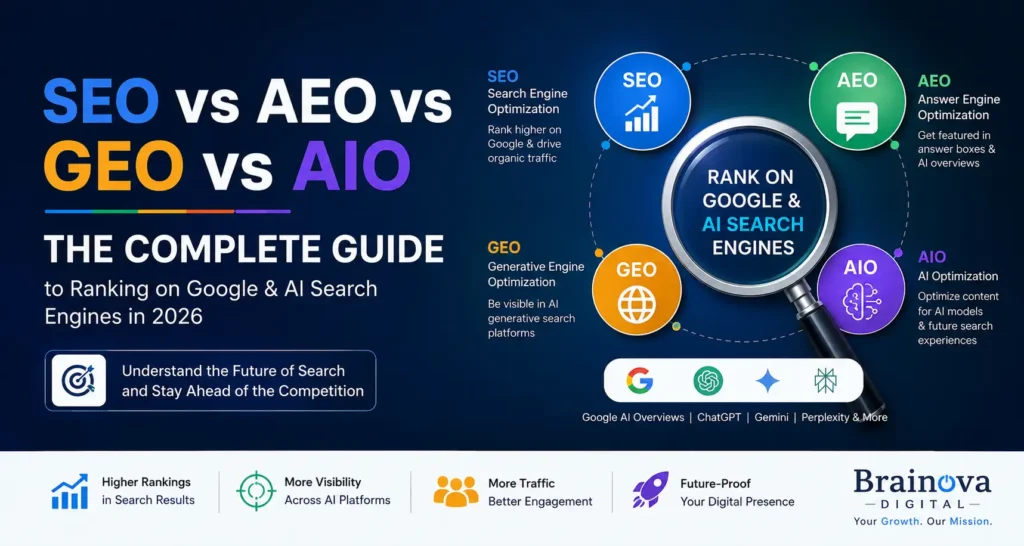
This is why the most forward-thinking digital marketers in 2026 are combining four distinct but complementary disciplines:
- SEO – Search Engine Optimization (Google, Bing)
- AEO – Answer Engine Optimization (Featured Snippets, Google AI Overviews, Voice Search)
- GEO – Generative Engine Optimization (ChatGPT, Gemini, Perplexity, Claude)
- AIO – AI Optimization (Semantic SEO, NLP, Entity SEO, AI content structuring)
In this guide, we’re going to break down every single one of these disciplines — what they are, how they work, how they differ, and most importantly, how to build an integrated strategy that earns you visibility everywhere your customers are searching.
Whether you’re a business owner, marketer, SEO professional, or agency looking to stay ahead of the curve, this is the most comprehensive resource you’ll find on this topic in 2026.
Let’s get into it.
What is SEO (Search Engine Optimization)?
The Foundation of Digital Visibility
Search Engine Optimization is the practice of improving your website’s visibility in organic (non-paid) search engine results — primarily Google, which holds roughly 92% of the global search market.
At its core, SEO works by helping search engines crawl, understand, and rank your content above competitors for queries your target audience is typing.
How Search Engines Work
Before you can optimize for search engines, you need to understand what they’re actually doing:
1. Crawling Search engines use bots (called crawlers or spiders) to discover web pages. Google’s primary crawler is called Googlebot. It starts from known pages and follows links to discover new ones. If your pages aren’t crawlable — due to robots.txt blocks, JavaScript rendering issues, or broken internal links — Google can’t find them.
2. Indexing Once crawled, pages are analyzed and stored in Google’s index — a massive database of content. Not every crawled page gets indexed; Google evaluates quality, relevance, and technical health before deciding what to index.
3. Ranking When a user searches, Google’s algorithm evaluates hundreds of ranking signals to determine which indexed pages best satisfy that query. The top results earn the most clicks. Google’s algorithm includes signals from PageRank (link authority), RankBrain (machine learning), BERT and MUM (NLP models), Core Web Vitals (page experience), and over 200 known factors.
The Four Types of SEO
On-Page SEO Everything you do on the page itself to signal relevance and quality:
- Title tags and meta descriptions
- Header hierarchy (H1, H2, H3)
- Keyword placement and density
- Content depth and comprehensiveness
- Internal linking strategy
- Image optimization (alt text, compression)
- URL structure
- Schema markup
Off-Page SEO Signals that come from outside your website, primarily:
- Backlink acquisition (quality and relevance matter far more than quantity)
- Brand mentions (linked and unlinked)
- Social signals and digital PR
- Guest posting and content partnerships
Technical SEO The infrastructure that allows search engines to effectively crawl and index your site:
- Site speed and Core Web Vitals
- Mobile responsiveness
- HTTPS security
- XML sitemaps
- Structured data implementation
- Canonical tags
- Crawl budget optimization
- Log file analysis
Local SEO Optimization for location-based searches:
- Google Business Profile optimization
- NAP consistency (Name, Address, Phone)
- Local citations
- Review generation and management
- Local schema markup
SEO Strengths
- Long-term, compounding traffic that doesn’t disappear when you stop paying
- High purchase intent from informational and transactional queries
- Brand credibility from organic visibility
- Still the highest volume search platform by far
SEO Limitations in 2026
- Zero-click searches eating into organic click-through rates
- AI Overviews displacing position 1 results
- Increasingly competitive SERPs
- Doesn’t capture AI search traffic from ChatGPT, Perplexity, or Gemini
What is AEO (Answer Engine Optimization)?
The Art of Being the Answer
Answer Engine Optimization is the practice of structuring and formatting your content so that search engines and AI answer systems can extract it and present it as a direct answer to user queries — without the user needing to click through to your website.
The key platforms AEO targets:
- Google’s Featured Snippets
- People Also Ask (PAA) boxes
- Google AI Overviews
- Voice search results (Google Assistant, Siri, Alexa)
- Knowledge panels
Why AEO Matters
When someone asks Google “What is content marketing?”, they often get a boxed answer at the top of the page — the featured snippet — that answers the question directly. That box doesn’t come from Google’s own content; it comes from a website that structured their content in a way Google could extract and display.
Here’s the interesting part: the site that earns the featured snippet often gets more brand recognition and trust than the sites ranking below — even if click-through rate drops. It’s the “position zero” effect.
With Google AI Overviews now appearing for hundreds of millions of queries, AEO has become mission-critical. If your content isn’t structured for extraction, you won’t appear in AI Overviews regardless of how well it ranks organically.
How Answer Engines Work
Google’s AI Overview is powered by Gemini, Google’s large language model. When generating an overview, it:
- Identifies the search intent and query type
- Scans its index for the most authoritative, clearly structured pages
- Extracts and synthesizes information into a coherent answer
- Attributes sources with links (usually 3–5 sites)
The pages most likely to be cited are those that:
- Directly answer the question in the first paragraph
- Use clear Q&A or definition-style structure
- Have strong topical authority
- Are on high-trust, well-linked domains
- Use schema markup (especially FAQPage, HowTo, Article)
AEO Optimization Strategies
Structure content for extraction: Start every section with a direct answer to the implied question. Don’t bury the lead. If the heading is “What is Answer Engine Optimization?”, the very next sentence should be a clean, concise definition.
Target question-based queries: Use tools like AlsoAsked, AnswerThePublic, or Google’s own PAA boxes to find the exact questions your audience is asking. Build content that answers these directly.
Use schema markup aggressively:
- FAQPage schema for FAQ sections
- HowTo schema for step-by-step guides
- Article schema for blog posts
- Speakable schema for voice search optimization
Write in concise, extractable formats: Featured snippets tend to be 40–60 words for paragraph snippets. For lists, Google typically shows 6–8 items. For tables, keep them clean and labeled. Match these formats deliberately.
Build topical depth: Google’s AI Overview favors sites with broad, deep coverage of a topic — not just one optimized article. Building a content cluster (pillar + supporting articles) significantly increases your chances of being cited.
AEO Checklist
- [ ] Every H2/H3 is phrased as a question or directly answers one
- [ ] Opening paragraph of each section answers the implicit question in 40–60 words
- [ ] FAQPage schema implemented on all FAQ sections
- [ ] HowTo schema on step-by-step content
- [ ] Content targets People Also Ask questions
- [ ] Internal linking connects all related content
- [ ] Mobile-responsive with fast load times
- [ ] E-E-A-T signals present (author bio, credentials, citations)
What is GEO (Generative Engine Optimization)?
Optimizing for AI-Generated Answers
Generative Engine Optimization is the practice of optimizing your content to be discovered, referenced, and cited by generative AI platforms — specifically large language models like ChatGPT, Gemini, Perplexity, and Claude when they generate answers to user queries.
This is a genuinely new discipline, coined by researchers at Princeton, Georgia Tech, and IIT Delhi in a 2023 paper titled “GEO: Generative Engine Optimization.” The research demonstrated that certain content optimization techniques could increase visibility in generative AI responses by up to 40%.
How Generative AI Engines Work
Unlike Google’s traditional algorithm — which retrieves pre-indexed pages — generative AI platforms synthesize new answers by:
- Drawing on training data (for models like ChatGPT-4, this includes a large portion of the public web)
- Using retrieval-augmented generation (RAG) to search current web sources (Perplexity does this for every query; ChatGPT does this when web search is enabled)
- Generating a coherent, cited response that synthesizes multiple sources
For GEO, the key insight is this: AI models don’t just rank pages — they decide whether your content is credible, relevant, and citable enough to reference in their generated answers.
GEO vs SEO: Key Differences
| Dimension | SEO | GEO |
|---|---|---|
| Target Platform | Google, Bing | ChatGPT, Gemini, Perplexity, Claude |
| Output | Ranked list of links | Generated answer with citations |
| Ranking Signals | Backlinks, keywords, technical | Authority, clarity, citations, trustworthiness |
| User Behavior | Click-through | Read answer in place |
| Keyword Focus | Exact-match and semantic | Conversational, intent-based |
| Content Format | Any | Structured, fact-dense, authoritative |
GEO Optimization Strategies
Build genuine topical authority: AI models are trained to recognize authoritative sources. This means having comprehensive content across a topic, not just a single optimized article. Create content clusters that cover every angle of your subject matter.
Get cited and linked across the web: The more your content, brand name, and data points appear across reputable websites, the more likely AI training data includes your work. PR campaigns, guest posts, data studies, and original research are GEO gold.
Use statistics, data, and original research: AI models love citing specific statistics. If you publish original data (“In our analysis of 500 campaigns…”), you become a citable source. This is one of the highest-leverage GEO tactics available.
Optimize for Perplexity specifically: Perplexity performs real-time web searches for every query, making it the most immediate GEO opportunity. It favors:
- Fast-loading, technically clean websites
- Clear, direct answers near the top of pages
- Well-structured content with headers
- HTTPS and credible domains
Write in a neutral, factual, encyclopedic tone: AI models are trained to prefer content that reads like an authoritative reference rather than marketing copy. Balance your promotional intent with genuinely useful, unbiased information.
Build brand entity recognition: Establish your brand as a recognized entity across the web. Wikipedia entries, LinkedIn company pages, press mentions, podcast appearances, and Wikidata listings all help AI models understand that your brand is a real, credible entity — not just a website.
What is AIO (AI Optimization)?
Optimizing for How AI Understands Content
AI Optimization is the broadest of the four disciplines. Where SEO, AEO, and GEO focus on specific platforms or outcomes, AIO is about fundamentally restructuring how you create, write, and organize content so that AI systems — whether they’re Google’s ranking algorithms, LLMs, or multimodal models — can understand, trust, and accurately represent it.
Think of AIO as the underlying infrastructure layer that makes all the other disciplines more effective.
Core Components of AIO
Semantic SEO Traditional SEO focused on keywords — exact strings of text. Semantic SEO focuses on meaning. Google’s BERT and MUM algorithms understand context, synonyms, and relationships between concepts. This means you no longer need to repeat “digital marketing agency London” fifteen times — you need to comprehensively cover the topic so that Google understands your page is genuinely about digital marketing agencies in London.
Semantic SEO in practice:
- Cover a topic comprehensively, not just surface-level
- Include related concepts, synonyms, and contextually relevant terms
- Build internal linking that creates topical maps
- Use LSI (Latent Semantic Indexing) keywords naturally
NLP Optimization Natural Language Processing is how AI models read and interpret text. Optimizing for NLP means writing in a way that’s unambiguous, well-structured, and easy for machines to parse:
- Use clear subject-verb-object sentence structures
- Avoid excessive jargon without definition
- Define technical terms when first introduced
- Use active voice where possible
- Create explicit connections between ideas
Entity SEO Google’s Knowledge Graph is built on entities — people, places, organizations, concepts, and the relationships between them. When Google understands your content in terms of entities rather than just keywords, it can connect your content to relevant queries even when the exact keywords aren’t used.
Entity SEO tactics:
- Use full proper names (not abbreviations) for people, places, and organizations
- Build structured data (Schema.org markup) to declare entities explicitly
- Create and verify your Google Business Profile
- Build Wikipedia/Wikidata presence for your brand
- Get mentioned alongside established entities in your industry
AI Content Structuring AI models parse content hierarchically. They look for:
- Clear heading structures (H1 → H2 → H3)
- Logical content flow
- Defined terms and concepts
- Tables and lists for comparative or structured information
- Explicit connections between claims and supporting evidence
E-E-A-T Signals Google’s quality evaluator guidelines center on Experience, Expertise, Authoritativeness, and Trustworthiness. In 2026, these signals matter more than ever — especially for YMYL (Your Money, Your Life) content. AIO involves systematically building E-E-A-T into your content:
- Author bylines with bios and credentials
- Citations and references to authoritative sources
- Regular content updates with accurate dates
- About pages that establish organizational credibility
- Security (HTTPS), privacy policies, and contact information
SEO vs AEO vs GEO vs AIO: Complete Comparison
Side-by-Side Comparison Table
| Factor | SEO | AEO | GEO | AIO |
|---|---|---|---|---|
| Primary Goal | Rank in organic search | Be the featured answer | Get cited by AI | Optimize for AI understanding |
| Main Platforms | Google, Bing | Google, Voice, AI Overviews | ChatGPT, Perplexity, Gemini | All AI systems |
| Core Tactics | Links, keywords, technical | Schema, Q&A structure, snippets | Authority, citations, data | Semantic, NLP, entity |
| Measurement | Rankings, organic traffic | Featured snippet rate, PAA | AI citation frequency | Content quality scores |
| Time to Results | 3–12 months | 4–8 weeks | Ongoing | Ongoing |
| Difficulty | High | Medium | Emerging | Medium |
| Traffic Type | Click-through traffic | Brand visibility, some traffic | Brand authority, some traffic | Improved performance across all |
When Should You Use Each?
Use SEO when:
- You want sustainable, long-term organic traffic
- Your audience primarily uses Google for research and purchase decisions
- You’re building a content marketing engine
- You have time for the investment to compound
Use AEO when:
- Your content answers specific questions
- You want visibility in Google AI Overviews
- You’re targeting voice search queries
- You want to dominate “position zero” featured snippets
Use GEO when:
- Your audience uses ChatGPT, Perplexity, or Gemini for research
- You want to be referenced as an industry authority
- You’re publishing original research or data
- You’re building brand credibility in your niche
Use AIO when:
- You want all your content to perform better across every platform
- You’re building a long-term content strategy
- You want AI systems to accurately represent your brand
- You’re investing in topical authority
The honest answer in 2026: Use all four, simultaneously.
These aren’t competing strategies. SEO provides the traffic foundation. AEO captures zero-click and AI Overview visibility. GEO earns citations from AI platforms. AIO improves the quality of everything else. They’re layers of the same system.
Why Traditional SEO Is Not Enough in 2026
The Zero-Click Revolution
Here’s a statistic that should change how you think about SEO: according to Semrush data, nearly 25% of desktop searches and over 17% of mobile searches resulted in zero clicks in 2023 — and that number has only grown as AI Overviews expand.
What does “zero-click” mean? It means the user typed a query, got their answer from Google’s own interface (AI Overview, featured snippet, knowledge panel, local pack), and never visited any website.
For certain query types — definitions, quick facts, weather, calculations, conversions — zero-click rates can exceed 80%.
AI Overviews Are Displacing Rankings
Google’s AI Overviews appear above all organic results, including the #1 ranked page. Studies show AI Overviews reduce click-through rates for the organic results below them by 20–30%, even for informational queries.
This doesn’t mean SEO is dead — far from it. But it does mean that ranking #1 is no longer automatically the jackpot it once was. You need to be in the AI Overview, not just below it.
The Fragmentation of Search
Your customers aren’t just on Google anymore. Consider:
- A startup founder researching a vendor might ask ChatGPT
- A student writing a paper might use Perplexity for citations
- A consumer comparing products might ask Gemini via their Android phone
- A professional doing market research might use Claude or Copilot
Each of these platforms has different citation criteria, different content preferences, and different ways of presenting your brand. If you only optimize for Google, you’re invisible on all the others.
Voice Search and Conversational Queries
By 2024, more than 1 billion voice searches were conducted monthly worldwide. Voice queries are fundamentally different from typed queries:
- Longer (full questions vs. fragments)
- Conversational (“What’s a good digital marketing agency near me?” vs. “digital marketing agency”)
- Intent-driven (usually want a direct answer, not a list of results)
Traditional SEO keyword strategies don’t adequately address this. AEO, GEO, and AIO all do.
How to Rank in ChatGPT, Gemini & Google AI Search: A Practical Framework
The 8-Pillar AI Visibility Framework
Pillar 1: Build Deep Topical Authority
AI models cite sources that clearly own a topic. Building topical authority means:
- Creating a comprehensive content cluster around your core subject (pillar page + 15–30 supporting articles)
- Covering beginner, intermediate, and expert-level content
- Answering every question your audience could have about the topic
- Interlinking all related content to establish topical maps
For example: if you’re a digital marketing agency, don’t just have one “What is SEO?” page. Build 25+ articles covering every dimension of digital marketing — and link them systematically.
Pillar 2: Entity SEO
Make your brand, your founders, and your key concepts “entities” that AI systems recognize:
- Complete and verify your Google Business Profile
- Create a Wikipedia page or Wikidata entry for your organization if eligible
- Ensure your brand is mentioned in context alongside established industry names
- Use Organization schema markup on your homepage
- Build LinkedIn, Crunchbase, and press presence that establishes organizational credibility
Pillar 3: Schema Markup Implementation
Schema markup is machine-readable code that tells AI systems exactly what your content is about. In 2026, critical schema types include:
- Article / BlogPosting – for editorial content
- FAQPage – for Q&A sections (massive for AI Overviews)
- HowTo – for step-by-step guides
- Organization – for brand pages
- Person – for author profiles
- Product – for e-commerce
- Review / AggregateRating – for credibility
- Speakable – for voice search optimization
Tools: Google’s Rich Results Test, Schema.org validator, Merkle’s Schema Markup Generator.
Pillar 4: Conversational, Intent-Driven Content
AI models are trained on conversational data. Content that reads naturally — like a knowledgeable person explaining something to a friend — performs better than robotic, keyword-stuffed text.
Write content that:
- Directly answers the question posed in each heading
- Uses natural transitions between ideas
- Acknowledges and addresses counterpoints
- Provides concrete examples and case studies
- Has clear takeaways at the end of each section
Pillar 5: Semantic SEO and NLP Optimization
Move beyond keyword targeting to meaning targeting:
- Use Clearscope, Surfer SEO, or MarketMuse to identify semantically related terms your content should cover
- Build content that comprehensively covers a topic (not just the exact query keyword)
- Use clear, unambiguous language that NLP models can parse
- Include definitions, explanations, and context for technical terms
- Structure your content with logical flow: problem → explanation → solution → proof
Pillar 6: Trust Signals and E-E-A-T
AI models are calibrated to avoid citing low-quality or untrustworthy sources. Build trust signals at every level:
Author level:
- Named author with bio and credentials
- Author’s own website, LinkedIn, and social profiles
- Published works, speaking engagements, or media mentions
Site level:
- About page with team, mission, and history
- Press coverage and backlinks from authoritative sites
- Security (HTTPS), privacy policy, clear contact information
- Transparent editorial standards
Content level:
- Citations and references to credible primary sources
- Accurate, up-to-date information with publication/update dates
- Original research, data, or unique perspectives (not just rehashed content)
Pillar 7: FAQ Optimization
FAQs are disproportionately powerful for AI search. Both Google AI Overviews and retrieval-augmented AI systems heavily weight Q&A-formatted content because it directly matches how users phrase queries.
Best practices:
- Include 10–20 FAQs at the bottom of every pillar article
- Mirror exact language from People Also Ask boxes and AI search suggestions
- Keep answers in the 50–100 word range (long enough to be useful, short enough to be extractable)
- Implement FAQPage schema on all FAQ sections
- Organize FAQs from most common/basic to most advanced
Pillar 8: Technical Excellence and Page Experience
Even the best content loses AI visibility if the technical foundation is broken:
- Page speed under 2.5 seconds (Core Web Vitals LCP)
- Mobile-first design
- Clean HTML structure that crawlers can parse
- Accessible (ARIA labels, proper alt text)
- No duplicate content issues
- Proper canonical tags
- XML sitemap up to date
The Complete SEO + AEO + GEO + AIO Strategy for Businesses
The Integrated Visibility Roadmap
Month 1–2: Foundation
Technical audit and fix:
- Run a full technical SEO audit (Screaming Frog, Semrush Site Audit)
- Fix crawlability and indexation issues
- Implement SSL, fix broken links, optimize site speed
- Ensure mobile responsiveness passes Core Web Vitals
Entity establishment:
- Verify and fully complete Google Business Profile
- Audit brand presence across web (Crunchbase, LinkedIn, press)
- Implement Organization schema on homepage
Content audit:
- Identify existing content that can be upgraded for AEO/GEO
- Map current content to search intent
- Identify topical gaps
Month 3–4: Content Architecture
Build topical authority structure:
- Define 3–5 core topic clusters for your business
- Create pillar pages for each cluster
- Plan 15–20 supporting articles per cluster
AEO-optimize existing content:
- Rewrite introductions to lead with direct answers
- Add FAQ sections with FAQPage schema
- Structure H2s as questions where appropriate
- Add HowTo schema to instructional content
Month 5–6: Content Production and Outreach
Publish content cluster content:
- Publish 2–4 supporting articles per week
- Ensure each is internally linked to the pillar
- Use semantic keyword research (not just volume-based)
Build GEO signals:
- Launch a data-driven original research piece or industry survey
- Begin digital PR outreach to get cited on authority sites
- Publish guest posts on industry publications
- Engage in HARO (Help a Reporter Out) to earn press citations
Month 7–12: Amplification and Monitoring
Monitor AI visibility:
- Track brand mentions in ChatGPT, Perplexity, and Gemini responses
- Use tools like Brandwatch or mention.com for brand monitoring
- Test your own queries in AI platforms — are you being cited?
Iterate and deepen:
- Double down on content that earns AI citations
- Update and expand high-performing articles
- Build more schema markup across your site
15 Common Mistakes Businesses Make (And How to Avoid Them)
- Ignoring AI search platforms entirely — Focusing only on Google while customers research you on ChatGPT and Perplexity. Fix: build a GEO strategy immediately.
- Keyword stuffing instead of semantic coverage — Repeating the same keyword 30 times instead of comprehensively covering a topic. Fix: use Clearscope or Surfer to identify semantic gaps.
- No schema markup — Leaving structured data unimplemented, making it harder for AI systems to understand your content. Fix: implement Article, FAQPage, and Organization schema as a minimum.
- Thin content — Publishing 500-word articles on complex topics. AI models overwhelmingly cite comprehensive, in-depth content. Fix: aim for 2,000+ words on competitive informational topics.
- Ignoring E-E-A-T — Publishing content without author attribution, credentials, or citations. Fix: add author bios, cite sources, and build author entity profiles.
- No FAQ sections — Missing out on the single highest-leverage AEO tactic. Fix: add 10–20 FAQs to every major page with FAQPage schema.
- Treating AI Overviews as a threat rather than an opportunity — Panicking about reduced CTR instead of optimizing to appear in overviews. Fix: structure content for extraction and target AI Overview citations.
- Poor internal linking — Content silos that prevent search engines from understanding your topical authority. Fix: build a systematic internal linking structure connecting all related content.
- Ignoring voice search — Not optimizing for conversational, question-based queries. Fix: include natural language variations of your target queries; use Speakable schema.
- No original data or research — Publishing only derivative content with no unique insights. Fix: conduct surveys, analyze your own customer data, publish case studies with real numbers.
- Inconsistent publishing — Sporadic content production that doesn’t build topical depth. Fix: commit to a sustainable publishing calendar (1–2x per week minimum).
- Not updating old content — Letting accurate, well-ranked content become outdated. Fix: schedule quarterly content audits and updates; include “last updated” dates.
- Ignoring Perplexity — Perplexity is the most immediately impactful GEO opportunity because it does real-time RAG search. Fix: optimize your highest-value pages for speed and direct-answer formatting.
- Building backlinks without earning citations — Focusing on SEO link building while ignoring the brand mentions and press citations that drive GEO. Fix: integrate link building with digital PR for dual-purpose authority building.
- No topical authority strategy — Publishing random content without a deliberate cluster strategy. Fix: map your content to 3–5 topic clusters and build systematically.
The Future of Search in 2026 and Beyond
AI-First Search Becomes the Default
We’re in the early stages of a fundamental shift in how humans find information. The traditional blue-links model — which has defined search for 25 years — is being gradually replaced by synthesized AI answers. This transition won’t happen overnight, but the direction is unmistakable.
Google’s own research shows that users prefer AI-generated answers for complex, research-oriented queries. For simple navigational queries (find a website) and local queries (find a restaurant near me), traditional search remains strong. But for the vast middle ground of informational, research, and comparison queries — where most content marketing lives — AI answers are winning.
Personalized AI Search Assistants
The next generation of search isn’t just about finding information — it’s about having a persistent AI assistant that knows your context, preferences, and history. Microsoft’s Copilot, Google’s personal AI features in Gemini, and Apple’s AI integration are early versions of this.
For businesses, this means brand familiarity matters even more. If a user asks their personal AI assistant “find me a good digital marketing agency,” that assistant will draw on everything it knows — your website, your reviews, your press mentions, your social presence — to make a recommendation.
Predictive and Proactive Search
AI is moving from reactive (answering questions) to proactive (anticipating needs). Google’s Search Generative Experience already offers follow-up questions; future versions will proactively surface relevant information before you even ask.
For content creators, this means your content needs to be genuinely useful — not just optimized for a specific query, but comprehensively valuable on a topic. AI assistants will surface your content in contexts you didn’t specifically target.
Search Without Clicks — And What Replaces Traffic
Zero-click will continue to grow. But the businesses that understand AI search recognize something important: AI citations create brand exposure even without clicks. When ChatGPT cites your website as the source for a key statistic, thousands of users see your brand name. That brand exposure compounds over time.
The new metric for GEO success isn’t just traffic — it’s citation frequency, brand mention volume, and AI recommendation share. These are the metrics that the most forward-thinking digital marketers are beginning to track in 2026.
Multimodal Search
AI search is rapidly moving beyond text. Google Lens, GPT-4V, and Gemini’s multimodal capabilities mean users can search by image, video, and audio. Optimizing for visual search — through proper image alt text, image schema, and high-quality visual content — is becoming an increasingly important dimension of AI search optimization.
Conclusion: The New Era of Digital Visibility
The search landscape in 2026 is more complex — and more opportunity-rich — than it’s ever been. Businesses that adapt to this new reality by combining SEO, AEO, GEO, and AIO will earn visibility across every platform their customers use. Those that don’t will find themselves increasingly invisible, even as they climb Google’s rankings.
The key takeaways from this guide:
- SEO remains the traffic foundation — don’t abandon it
- AEO earns you visibility in Google AI Overviews and featured snippets — structure your content for extraction
- GEO gets your brand cited by ChatGPT, Gemini, and Perplexity — build authority, publish data, earn press
- AIO makes all of the above more effective — optimize for semantic understanding, entities, and NLP
The businesses winning search in 2026 aren’t choosing between these strategies. They’re running all four simultaneously, with a content strategy designed from the ground up to be visible everywhere.
Ready to Dominate Google and AI Search in 2026?
At Brainova Digital, we specialize in integrated SEO + AEO + GEO + AIO strategies built specifically for the AI search era. We don’t just help you rank on Google — we build your brand’s visibility across ChatGPT, Gemini, Perplexity, Google AI Overviews, and every search platform your customers are using.
What we do:
- Full-stack SEO audits and implementation
- AI search optimization strategies (GEO + AEO)
- Content cluster architecture for topical authority
- Schema markup and structured data implementation
- Digital PR and citation-building campaigns
- AI visibility monitoring and reporting
If you’re serious about dominating search in 2026 and beyond, we should talk.
Book a Free AI Search Visibility Consultation → brainovadigital.com
Frequently Asked Questions (FAQs)
Is SEO dead because of AI?
No — SEO is not dead, but it has evolved significantly. Traditional SEO still drives the majority of organic traffic, and Google remains the world’s dominant search platform. However, SEO alone is no longer sufficient. The rise of AI Overviews, zero-click searches, and AI search platforms like ChatGPT and Perplexity means businesses must complement SEO with AEO, GEO, and AIO strategies to maintain comprehensive search visibility.
What is AEO (Answer Engine Optimization)?
Answer Engine Optimization (AEO) is the practice of structuring content so that search engines and AI systems can extract it as a direct answer to user queries. AEO targets Google’s Featured Snippets, People Also Ask boxes, AI Overviews, and voice search results. It involves writing concise, direct answers to questions, implementing schema markup, and building content that answers specific user queries in extractable formats.
What is GEO (Generative Engine Optimization)?
Generative Engine Optimization (GEO) is the practice of optimizing content to be cited and referenced by generative AI platforms like ChatGPT, Gemini, Perplexity, and Claude. Unlike traditional SEO (which targets ranked link lists), GEO targets AI-generated answers that synthesize information from multiple sources. GEO focuses on building topical authority, earning citations from credible websites, publishing original data, and structuring content for AI comprehension.
What is AIO (AI Optimization)?
AI Optimization (AIO) is the practice of structuring content so that AI systems — including both search engines and large language models — can accurately understand, interpret, and represent it. AIO encompasses semantic SEO, NLP optimization, entity SEO, and E-E-A-T signal building. It’s the foundational layer that makes SEO, AEO, and GEO more effective.
How do I rank in ChatGPT?
To appear in ChatGPT responses, focus on: (1) building genuine topical authority through comprehensive content clusters, (2) earning citations and backlinks from authoritative websites in your industry, (3) publishing original research with specific data points AI models can cite, (4) establishing your brand as a recognized entity (Google Business Profile, press mentions, LinkedIn), and (5) ensuring your content is structured clearly for AI comprehension. ChatGPT’s knowledge base is based on training data, so prominence across the web is key.
What is Google AI Overview?
Google AI Overview (formerly Search Generative Experience/SGE) is Google’s AI-powered feature that appears at the top of search results for many queries. It generates a synthesized answer to the user’s question using Google’s Gemini model, with links to source pages. AI Overviews reduce organic click-through rates but offer massive brand visibility for sites that are cited. To appear in AI Overviews, optimize for AEO: use schema markup, direct-answer formatting, strong E-E-A-T signals, and comprehensive topical coverage.
Which is better: SEO or AEO?
Neither is “better” — they’re complementary. SEO earns organic traffic from ranked search results. AEO earns visibility in featured snippets, AI Overviews, and voice search. In 2026, a business should pursue both simultaneously. Think of SEO as the traffic engine and AEO as the brand visibility multiplier. Combined, they maximize your presence across all Google search surfaces.
Can my website rank in AI search engines?
Yes, absolutely. Websites can be cited in AI search engines like Perplexity (which does real-time web search), ChatGPT (when web search is enabled), and Google AI Overviews. The key is optimizing for GEO: building topical authority, earning authoritative backlinks, publishing clear and well-structured content, implementing schema markup, and establishing your brand as a credible, trustworthy entity. Sites that do this consistently earn regular AI citations.
How do I optimize content for AI search?
Optimize content for AI search by: (1) covering topics comprehensively rather than superficially, (2) structuring content with clear H1–H3 hierarchy, (3) including direct Q&A sections with FAQPage schema, (4) citing authoritative sources, (5) adding author bios with credentials, (6) publishing original data and case studies, (7) building topic clusters with strong internal linking, (8) implementing relevant Schema.org markup, and (9) ensuring technical excellence (speed, mobile-first, clean HTML).
Is GEO the future of SEO?
GEO is a critical component of the future of search, but not a replacement for SEO. The future involves a blended approach: SEO for organic Google traffic, GEO for AI platform citations, AEO for featured and AI-generated answers, and AIO for foundational content quality. As AI search grows — and it will continue to grow — GEO importance will increase proportionally. Businesses that invest in GEO now will have a significant advantage within 2–3 years.
What is topical authority and why does it matter for AI search?
Topical authority means being recognized by search engines and AI models as a comprehensive, expert source on a specific subject. It’s built by creating a deep content library that covers every dimension of your core topics. Topical authority matters for AI search because AI models are trained to prefer citing authoritative sources — sites that clearly own a topic — rather than sites with a single good article. It’s one of the most powerful signals you can build for both Google rankings and AI citations.
How does semantic SEO differ from traditional keyword SEO?
Traditional keyword SEO focuses on using specific keyword strings to signal relevance. Semantic SEO focuses on covering the full meaning of a topic — including related concepts, questions, entities, and context — so that AI systems understand your content comprehensively. Google’s BERT and MUM algorithms understand language at a semantic level, meaning comprehensive coverage of a topic now outperforms keyword repetition.
What is entity SEO?
Entity SEO is the practice of optimizing your content and digital presence in terms of real-world entities — people, places, organizations, concepts, and their relationships. Google’s Knowledge Graph and most AI models understand the world through entities. Entity SEO involves implementing structured data that declares entities explicitly, building mentions across authoritative sites, and creating content that connects your brand to established entities in your industry.
How long does GEO take to show results?
GEO is an ongoing process rather than a one-time campaign. For Perplexity (which does real-time search), well-optimized pages can start appearing in AI results within weeks. For ChatGPT and Claude (which rely on training data), visibility depends on how widely your content is cited across the web and when the next model training cycle incorporates new data. Generally, expect 3–6 months for measurable GEO results, with results compounding over 12–18 months.
What schema markup is most important for AI search?
The most important schema types for AI search in 2026 are: FAQPage (highest impact for AI Overview citations), Article/BlogPosting (for editorial content), Organization (for brand entity recognition), HowTo (for instructional content), Person (for author E-E-A-T), and Speakable (for voice search). At minimum, implement FAQPage on all FAQ sections and Organization schema on your homepage.
What is zero-click search?
Zero-click search refers to search queries where the user gets their answer directly from the search results page — through a featured snippet, AI Overview, knowledge panel, or other SERP feature — without clicking through to any website. Zero-click searches now account for a significant portion of all Google searches. While zero-click reduces traffic to individual websites, it creates brand visibility opportunities for businesses whose content is cited in these on-page answers.
How do I appear in Google AI Overviews?
To appear in Google AI Overviews: (1) build strong topical authority on your subject, (2) use AEO formatting — lead with direct answers, use clear Q&A structures, (3) implement FAQPage and Article schema markup, (4) earn high-quality backlinks from authoritative sources, (5) ensure your content is comprehensive (long-form, covering all angles), (6) demonstrate strong E-E-A-T signals, and (7) optimize your technical SEO so Google can efficiently crawl and index your pages.
Does publishing original research help with GEO?
Yes — original research and proprietary data are among the highest-leverage GEO tactics available. When you publish a unique statistic or finding, AI models can cite your work as a primary source. This is dramatically more effective for GEO than rehashing information available elsewhere. Industry surveys, customer data analysis, A/B test results, and case studies with real numbers are all excellent original research formats.
What is the difference between AEO and GEO?
AEO (Answer Engine Optimization) focuses on traditional AI-assisted search within Google — specifically Featured Snippets, People Also Ask boxes, and Google AI Overviews. GEO (Generative Engine Optimization) focuses on standalone generative AI platforms like ChatGPT, Gemini, Perplexity, and Claude. Both involve structuring content for AI comprehension, but AEO is more Google-centric while GEO targets the broader AI platform ecosystem.
How important is E-E-A-T for AI search?
E-E-A-T (Experience, Expertise, Authoritativeness, Trustworthiness) is critically important for both Google’s ranking algorithm and AI citation behavior. AI models are calibrated to prefer citing credible, expert sources. A page with named expert authors, citations, regular updates, and organizational credibility signals will consistently outperform anonymous, citation-free content in AI search results. E-E-A-T is one of the most important foundational investments for AI search visibility.
Can small businesses compete in AI search?
Absolutely. In fact, AI search partially levels the playing field. A small business that builds genuine topical authority on a narrow subject, publishes original data in their niche, and earns citations from relevant industry sites can earn AI citations that previously would have required massive domain authority. The key is going deep on a specific niche rather than competing broadly. Hyperspecialized expertise is rewarded by AI models.
What tools help with GEO and AEO optimization?
Useful tools include: Semrush / Ahrefs (SEO foundation), Surfer SEO / Clearscope (semantic content optimization), Schema App / Merkle Schema Generator (schema markup), AlsoAsked / AnswerThePublic (question research), Google Search Console (performance monitoring), Brandwatch / Mention (AI brand mention monitoring), Perplexity AI (test your GEO visibility directly), and Google’s Rich Results Test (schema validation).
Is voice search still relevant in 2026?
Yes. Voice search continues to grow, particularly for local and quick-information queries. More importantly, conversational AI assistants (Google Assistant, Siri, Alexa, Copilot) are increasingly handling queries that would previously have been typed searches. Optimizing for voice means optimizing for AEO: natural language content, direct answers to questions, local schema markup, and Speakable schema for content you want read aloud.
How does Perplexity AI rank content?
Perplexity uses real-time retrieval-augmented generation (RAG) — it searches the live web for every query and synthesizes citations from what it finds. This makes it the most immediately responsive AI platform for GEO. Perplexity favors: fast-loading, technically clean websites; clear, well-structured content; direct answers near the top of pages; authoritative domain scores; and comprehensive coverage of the query topic. Optimizing your top pages specifically for Perplexity’s crawlers is a high-ROI GEO tactic.
How do I measure AI search performance?
Measuring AI search performance requires a mix of approaches: (1) track Google AI Overview appearances via Google Search Console (impression data), (2) manually test brand and product queries in ChatGPT, Gemini, and Perplexity and record citation frequency, (3) monitor brand mention volume across the web using Brandwatch or Mention, (4) track referral traffic from Perplexity.ai in Google Analytics, and (5) set up regular “brand query” monitoring to see how AI platforms describe your business.
What content formats work best for AI citations?
Content formats that consistently earn AI citations include: comprehensive pillar articles (2,000+ words), original research pieces with specific data, well-structured comparison guides (like this one), FAQ sections with direct answers, step-by-step how-to guides with clear numbering, case studies with real outcomes, and definition/explanation pieces for technical concepts. Short, thin content rarely gets cited by AI models.